



Transport ponadnormatywny maszyn budowlanych i drogowych
Oversized transport of construction and road machinery requires a thorough assessment of weight, dimensions, axle loads, attachments, loading method, and route. The transport of a crawler excavator is planned differently from that of a bulldozer with a blade, road roller, asphalt milling machine, paver, mobile crusher, piling rig, drilling rig, crane, or mobile concrete batching plant.
1. What is oversized transport?
Oversized transport of construction and road machinery concerns the carriage of equipment that, after being loaded onto a vehicle, exceeds the standard parameters permitted in road traffic. The excess may result from the width, height, length, actual gross weight of the combination or axle loads.
In practice, clients usually notice the problem only when the machine does not fit on a standard car transporter, when the carrier asks for exact dimensions, when a low-loader trailer needs to be selected, or when it turns out that a permit, escort vehicle or detailed route analysis will be required. In oversized transport, the machine name alone is not enough. Technical data is necessary, as is determining the configuration in which the machine will actually be transported.
For construction and road machinery, the following are particularly important: chassis width, height after positioning on the trailer, length with attachments, operating weight, the possibility of dismantling components, the location of the centre of gravity and the loading method. The same excavator, loader, grader, crusher, piling machine or asphalt paver may require a different transport combination depending on its version, equipment, route and collection location.
That is why the transport of an oversized construction or road machine should be planned as a technical and logistics project, rather than as an ordinary transport order. First, the machine parameters and loading conditions are established, then the combination is selected, the route is checked, the formalities are determined, and only afterwards are the actual cost and schedule confirmed.
2. When does machine transport become oversized transport?
Whether machine transport is oversized is determined not by the name of the equipment, but by the actual parameters of the loaded combination. Excavators, loaders, rollers, road milling machines, mobile crushers or cranes may be transported in different configurations. Sometimes the problem is the width, sometimes the height after positioning on the trailer, sometimes the length, and sometimes the weight or axle loads.
In Polish regulations, the concepts of a non-standard vehicle and indivisible load are of key importance. A non-standard vehicle is a vehicle or combination of vehicles whose dimensions, axle loads or actual gross weight exceed the permitted limits. An indivisible load is one that cannot be divided into two or more smaller loads without disproportionately high costs or the risk of damage.
This has very practical significance for the transport of construction machinery. If the bucket can be removed from an excavator, the blade from a bulldozer, the counterweights from a crane, or the working equipment from a piling machine, it is necessary to assess before preparing a quotation whether dismantling will reduce the dimensions, simplify the route or lower the formal category of the journey. Sometimes transporting the machine in one piece is possible, but expensive and difficult to organise. In other cases, dividing it into the main machine and its equipment makes it possible to reduce the width, height, length or weight of the combination.
The biggest mistake when pricing oversized transport is assuming that “excavator transport”, “roller transport” or “crusher transport” always looks the same. In practice, the actual data matters: model, weight, transport dimensions, equipment, whether the machine can move under its own power, attachment points, access to the site and route restrictions.
3. What machines are covered by oversized transport of construction and road machinery?
This publication covers construction and road machinery exclusively. It does not discuss industrial relocations, the transport of production machinery, factory installations or the general transport of other oversized loads. The subject is the carriage of equipment used for earthworks, roadworks, infrastructure, foundation work, crushing, screening, concreting, lifting and construction-site operations.
| Machine group | Examples | Most common issues to check |
|---|---|---|
| Earthmoving machinery | mini excavators, wheeled excavators, tracked excavators, long-reach excavators, backhoe loaders, loaders, bulldozers, scrapers | weight, track or tyre width, cab height, bucket, boom, blade, ripper, ability to drive onto the trailer |
| Road machinery | graders, rollers, road milling machines, asphalt pavers, paving machines, soil stabilisers, recyclers, distributors | working width, screed, conveyor, drum, folding components, height after loading |
| Crushing and screening | jaw crushers, cone crushers, impact crushers, rubble crushers, mobile screens, sorters, conveyors, crushing plants | length, weight, centre of gravity, conveyors, feed hoppers, transport position |
| Foundation work and drilling | drilling rigs, piling machines, pile drilling rigs, pile drivers, HDD rigs, directional drilling machines, pipe-laying machines | mast, counterweights, drill rods, booms, working components, ability to divide the load |
| Cranes and access equipment | tower cranes, mobile cranes, self-propelled cranes, rough-terrain cranes, crawler cranes, boom lifts, mobile elevating work platforms | whether the complete machine or components are being transported, ballast, booms, supports, height when folded |
| Concrete and infrastructure | concrete pumps, concrete pavers, batching plants, mobile concrete plants, pipe-laying machines | number of modules, tanks, silos, supports, pipelines, frame, dismantling method |
The most important rule is simple: the machine name is not enough for a responsible quotation. In oversized transport of construction and road machinery, the transport configuration matters, not just the type of equipment.
4. Transport of construction machinery within Poland, from abroad, to Poland and from/to ports
Transport of construction machinery within Poland usually begins by determining whether the equipment can be carried on a domestic route without special restrictions, or whether a permit, escort vehicle, detour or different trailer will be required. A short distance does not always mean a straightforward operation. Sometimes a bridge, low overpass, roundabout, narrowing, local road, overhead line, weight restriction or difficult access to the construction site is a greater problem than the number of kilometres.
Transport of construction machinery from abroad to Poland and international transport of road machinery require additional coordination. The regulations of the transit countries, permit deadlines, border-crossing points, escort rules, sales or collection documents and contact with the person responsible on the seller’s side must all be taken into account. Typical routes in this segment include, among others, transporting an excavator from Germany to Poland, transporting a machine from the Netherlands, Belgium, France, Italy, the Czech Republic, Denmark, Sweden or Ukraine, as well as transporting machines from Poland to other European countries.
Transporting machines from and to ports is a separate group. This applies to imported, exported or transhipped machines moving between sea, ferry and road transport. In such projects, not only the machine’s weight and dimensions are important, but also pre-notification, port time windows, customs clearance, collection sequence, availability of handling equipment, terminal formalities and the possibility of providing a suitable trailer within the required timeframe.
For SEO and business purposes, it is useful to distinguish several typical customer intentions: transport of a construction machine within Poland, transport of a construction machine from abroad, transport of a construction machine to Poland, international transport of a road machine, transport of a construction machine from a port and transport of a construction machine to a port. All these queries concern a similar area, but differ in the scope of formalities and organisational risk.
5. Transport of excavators, loaders, bulldozers and earthmoving machinery
Excavator transport is one of the most common subjects in the construction machinery segment, but not every excavator represents the same transport project. A mini excavator can often fit into a simpler configuration, whereas transporting a tracked excavator, long-reach excavator or material-handling excavator may require a low-loader trailer, dismantling of equipment, verification of the transport height and precise positioning of the centre of gravity.
When transporting a wheeled excavator, weight, height and the total length with the boom are important. In the case of a tracked excavator, the undercarriage width, track pressure on the trailer deck, the ability to drive up the ramps and the method of securing the machine must also be considered. Long-reach excavators require an additional decision as to whether the boom will travel with the machine or be transported separately.
Backhoe loader transport can be simpler than transporting a large tracked excavator, but it still requires checking the cab height, length with equipment, position of the rear boom, bucket width and the ability to drive onto the trailer. In many cases, it is the equipment rather than the machine itself that causes the dimensions to be exceeded.
Transport of a loader, wheeled loader, telescopic loader, skid-steer loader or compact loader requires checking the tyre width, cab height, boom position and weight with equipment. Telescopic loaders are particularly sensitive to boom positioning, while for wheeled loaders the weight distribution and stable positioning on the trailer are important.
Bulldozer transport is one of the more demanding types of transport in this group. The usual problems are the blade width, machine weight, tracked undercarriage and the possibility of dismantling the equipment. Transporting the blade or ripper separately can sometimes reduce the width of the combination, simplify the route and limit formal risks. Scraper transport, in turn, requires assessing the length, height, axle arrangement and the possibility of safely positioning the machine on the combination.
For earthmoving machinery, a complete set of data is the basis for a good quotation: model, weight, transport dimensions, photographs, information about the equipment, loading and unloading method and the availability of manoeuvring space. If the client does not have a technical data sheet, it is worth taking measurements on site before confirming the price.
6. Transport of road machinery: graders, rollers, milling machines, pavers and stabilisers
Transporting road machinery often requires a different approach than transporting a conventional excavator or loader. Road machines can be long, low, wide and equipped with working components, feeding systems, tanks, drums, screeds or folding systems. The trailer selection therefore depends not only on the weight, but also on the machine’s geometry.
Grader transport requires checking the total length, width with the blade, cab height and the possibility of positioning the machine in a stable manner and in accordance with permissible axle loads. Graders are often problematic because of their length and working component, which may require suitable positioning or dismantling.
Transport of a road roller or padfoot roller requires attention to the weight concentrated on the drum, the loads on the trailer deck and the method of securing the machine. A roller may seem like a simple load, but its weight is concentrated and the contact area with the deck requires proper protection against shifting.
Road milling machine transport usually requires analysis of the height, width, conveyor arrangement, milling drum and folding components. The height after loading and the possibility of reducing the dimensions by folding or dismantling working components can be critical.
Asphalt paver transport requires checking the width of the screed, whether the side elements can be folded, the machine’s weight and the method of driving onto the trailer. The transport width, protruding elements and the need to properly secure the working components can be problematic.
Transport of a road recycler and soil stabiliser usually means greater weight, unusual width and the need to assess the working drum, undercarriage and transport height. In the case of distributors and shoulder pavers, tanks, working arms and side components must also be checked. A minor design difference can significantly change the quotation and transport requirements.
7. Transport of crushers, screens, sorters and mobile crushing plants
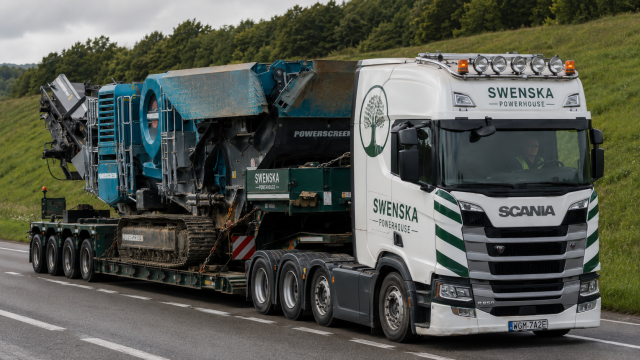
Crusher and screen transport is a separate group of oversized transport operations because these machines often combine considerable weight, significant length, tall folding components and an unusual centre of gravity. This applies to jaw crushers, cone crushers, impact crushers, rubble crushers and mobile crushing plants.
Jaw crusher transport requires checking the weight, length, feed height, conveyors and the method of positioning the machine on the trailer. Cone and impact crushers may differ in weight distribution, structural height and loading requirements. In each case, it must be determined whether the machine is self-propelled or requires a crane, winch or another loading method.
Transport of a mobile screen requires assessing the conveyors, feed hoppers, folding components and transport position. A trommel screen may have different geometry from a conventional mobile screen, so the machine name alone is not enough. The dimensions after folding and whether the conveyors and guards are properly secured must be confirmed.
Transport of a sorter, conveyor belt, screening plant or crushing plant requires determining whether a complete machine, a module, part of a production line or a set of several components is being transported. If the components can be safely separated, dividing the transport into several loads may sometimes be more advantageous.
Transport of a construction wood chipper, construction shredder or stabilisation unit requires a similar analysis: weight, height, width, undercarriage, transport position, attachment points and loading method. The greatest risk in this group is relying on catalogue dimensions without checking the machine’s actual configuration before loading.
8. Transport of drilling rigs, piling machines, pile drivers and drilling equipment
Transport of a drilling rig, piling machine, pile drilling rig or pile driver is among the more technical types of transport in the construction segment. These machines often have masts, counterweights, vertical components, working frames and equipment that must be placed in the transport position. It is essential to determine whether the machine will travel as a whole or after dismantling its working components.
When transporting piling machines and pile drivers, the height after folding the mast, total length, weight with counterweights and centre of gravity are particularly important. In many projects, drill rods, tools, equipment or counterweights must be transported separately in order to reduce the dimensions of the main load.
Transport of an HDD rig and drilling machine requires assessing the undercarriage, weight, frame length, guiding components and the ability to drive onto the trailer. For machines used in directional drilling, it is also important to establish whether drill rods, power units, equipment, technical containers or additional modules are being transported.
Vacuum excavator transport may be oversized depending on the dimensions, bodywork, weight and configuration of the vehicle or module. If the equipment is a registered specialist vehicle, the formal situation may differ from that of a typical machine loaded onto a trailer. It must be distinguished whether the machine is being transported as a load or whether a specialist vehicle is making a journey under its own classification.
Pipe-laying machine transport requires checking the length, width, boom, counterweights and the possibility of safely positioning the machine. With equipment used for linear construction work, the problem may be not only the machine’s dimensions but also difficult access to the loading or unloading location.
9. Transport of cranes, lifting equipment, boom lifts and mobile elevating work platforms
Transport of cranes and lifting equipment may involve complete machines as well as their components: counterweights, boom sections, undercarriages, upper structures, tower sections, supports, trolleys and equipment. It must always be determined whether the subject of transport is a complete machine, a component or several independent loads.
Transport of a tower crane usually does not mean transporting one complete machine, but rather many components: tower sections, jib, counter-jib, base, cab, mechanisms and ballast. Some components may be standard, while others may be oversized or heavy. The quotation should include the number of transports, delivery sequence and unloading possibilities at the construction site.
Transport of a mobile crane, self-propelled crane, rough-terrain crane or crawler crane depends on the weight, axle arrangement, height, equipment and whether the machine travels under its own power or as a load on a trailer. With crawler cranes, the dismantling of tracks, the boom and counterweights is often also an issue.
Transport of a boom lift and mobile elevating work platform requires checking the height when folded, length, width, weight and centre of gravity. Scissor lifts, telescopic platforms and articulated platforms may differ significantly, so it should not be assumed that every platform will require the same transport combination.
With lifting and access equipment, the correct securing of moving components is important. Booms, baskets, supports, ballast and folding components must be prepared for transport so that they cannot change position while driving.
10. Transport of concrete equipment, pipe-laying machines and infrastructure machinery
Transport of a concrete paver, concrete pump, batching plant or mobile concrete plant requires determining whether a single machine, bodywork, process module, tank, conveyor, silo, frame or complete set of components is being transported. In this group, it is easy to confuse the transport of one machine with the transport of several connected components.
Concrete pump transport may concern a vehicle with a mounted body or a component carried as a load. If the pump travels as a vehicle, different parameters are analysed than when it is transported as a machine on a trailer. With larger pumps, attention must be paid to the boom, supports, height and weight.
Transport of a batching plant or mobile concrete plant often requires division into modules. Even if the equipment is described as mobile, this does not automatically mean that it can be transported without oversized-transport formalities. The key factors are the actual dimensions after folding, the number of components, the weight of each module and the loading method.
Transport of a concrete paver and pipe-laying machine requires assessing the working structure, width, length and the possibility of stably positioning the machine. In infrastructure works, a frequent limitation is the loading and unloading area: a construction site, service road, shoulder, unpaved ground or restricted access.
11. What data is needed to quote the transport of a construction or road machine?
A reliable quotation for oversized transport of construction and road machinery requires specific technical data. The machine name and transport route alone are usually not enough. The basis is the model, manufacturer, year of manufacture, weight, length, width, height, equipment configuration and information on whether the machine is operational and can drive onto the trailer under its own power.
Transport dimensions are the most important, meaning the dimensions in which the machine will actually travel after being prepared for transport. Catalogue operating dimensions may differ from transport dimensions. If a blade, bucket, screed, conveyor, boom, mast, jib or support can be folded or dismantled, this must be established before preparing the quotation.
| Data required for the quotation | Why it matters |
|---|---|
| Manufacturer, model, version, year of manufacture | make it possible to find the technical data sheet and check the typical transport configuration |
| Operating weight and weight with equipment | determine the trailer, axle loads, permits and loading possibilities |
| Transport length, width and height | determine whether the transport will be oversized and which route can be used |
| Photographs from every side and the data plate | help identify equipment, modifications, protruding components and the machine’s actual condition |
| Loading and unloading addresses | make it possible to assess access, local roads, manoeuvring space and site limitations |
| Information on whether the machine is operational | determines whether self-loading, a winch, ramp, auxiliary loader or crane is required |
| On-site contact person | reduces the risk of downtime and errors on the loading day |
Additional information may be required for heavier machines: attachment points, centre of gravity, loads, support method, the manufacturer’s transport requirements, permissible approach angles and information on whether a crane, ramp or winch is needed. The more accurate the data at the beginning, the lower the risk of a price or schedule change on the loading day.
12. Selecting a trailer for transporting construction and road machinery
Trailer selection depends on the dimensions, weight, height, centre of gravity, loading method and route. Low-loader trailers, semi-low-loader trailers, tiefbett, lowbed, platform trailers, extendable platforms, telescopic trailers, detachable gooseneck trailers, combinations with ramps, dolly combinations, hydraulic modules and special configurations are most commonly used for transporting construction and road machinery.
A low-loader trailer is suitable for many excavators, loaders, rollers, graders and smaller road machines. Its advantage is the lower deck height and the ability to transport machines that should not exceed height restrictions on the route after loading.
A semi-trailer can be a good solution for many wheeled machines and some road machinery, especially when the machine can drive on under its own power using ramps. For loaders, rollers, graders, smaller excavators and some pavers, not only the payload capacity but also the approach angle, deck length and weight distribution matter.
Tiefbett or lowbed trailers are used where reducing the transport height is crucial. This solution is important for tall machines, equipment with large cabs, working components or a high centre of gravity. A detachable gooseneck trailer can facilitate loading heavy tracked machines from the front.
An extendable or telescopic platform is important for long machines and components, such as crane parts, long conveyors, pipe-laying machines or road machinery components. For very heavy or unusual loads, modular combinations and hydraulic modules may be used, allowing the weight and axle loads to be distributed more effectively.
There is no single universal trailer for all construction and road machinery. The same type of equipment may require a different configuration depending on its attachments, chassis version, height, weight and route. The combination should therefore be selected based on technical data, not merely on the machine name.
13. Permits, escort vehicles and route planning
If the combination carrying the machine exceeds the standard parameters permitted in road traffic, a permit for the movement of a non-standard vehicle may be required. The category and scope of the formalities depend on the combination’s parameters, the type of road and the planned route.
In Poland, the permit system includes categories I–V. In simplified terms, the greater the excess in dimensions, weight or axle loads, the more important it is to analyse the route, bridges, overpasses, road restrictions and arrangements with road authorities. For some journeys, permit-issue deadlines are also important, and more demanding transports may require preparation well in advance.
An escort vehicle may be required due to the length, width, height or actual gross weight of the combination. The escort’s task is not limited to driving in front of the combination, but also includes securing traffic, warning other road users, assisting with manoeuvres and reducing risks along the route.
For the transport of construction and road machinery, bridges, overpasses, roundabouts, traffic islands, height restrictions, narrow sections, roadworks, weight bans, power lines, trees, signage and the geometry of bends are particularly important. A route that looks suitable on a map is not always suitable for an oversized combination.
For international transport, a single universal procedure for the whole of Europe should not be assumed. Transporting an excavator from Germany to Poland may involve different arrangements from transporting a bulldozer from the Netherlands, a crusher to the Czech Republic, a road machine from France or equipment through several transit countries. Permit rules, escorts, time windows, speed limits and the practices of the authorities issuing approvals may all differ.
For the client, the most important point is not to order transport solely on the basis of the lowest price. If the transport requires a permit, escort or special route, inadequate organisation may result in the journey being stopped, delays, additional costs, a change of combination or problems during an inspection.
14. Loading, securing and preparing the machine
Preparing a machine for transport begins before the combination arrives. It must be determined whether the machine is operational, whether it can drive onto the trailer under its own power, or whether it requires a crane, ramp, winch, auxiliary loader or additional equipment. It is also necessary to check whether the loading area is paved, whether the combination has room to manoeuvre and whether there are height or width restrictions.
The machine should be placed in its transport configuration. Booms, buckets, blades, screeds, conveyors, masts, supports, baskets and jibs must be folded, secured or prepared in accordance with the manufacturer’s instructions. Components that can move should be immobilised.
Load securing must take into account the weight, centre of gravity, attachment points, type of undercarriage and the risk of shifting. A road roller is secured differently from a tracked excavator, a mobile crusher, a boom lift or a crane component.
In practice, with construction and road machinery, the manufacturer’s attachment points, the possibility of using chocks, the condition of the ramps, permissible loading angles and the method of blocking moving components are very important. The mere fact that the machine is standing stably on the trailer does not yet mean that it has been properly prepared for transport.
It is also important to remove loose components, material residue, mud, stones and parts that could fall off during the journey. This stage is particularly important for crushing, screening and road machinery, which often operates in difficult conditions and requires basic preparation before transport.
15. What affects the cost of oversized machine transport?
The cost of oversized transport of construction and road machinery is affected by several groups of factors. The first is the machine itself: weight, width, height, length, equipment, centre of gravity, the possibility of dismantling and the loading method. The second is the route: distance, transit countries, bridges, overpasses, road restrictions, required detours and the availability of suitable roads.
The third group consists of formalities: permits, waiting times, arrangements with road authorities, the need for an escort and any time restrictions. The fourth group concerns operational organisation: the availability of the right trailer, tractor unit, driver, escort vehicles, loading equipment and time slots at the construction site.
The price of transporting an excavator, loader, bulldozer, roller, milling machine, paver, crusher or piling machine is therefore not simply a rate per kilometre. Two machines may travel along a similar route but require completely different combinations, numbers of axles, loading methods, permits and preparation.
The simplest transport can be arranged relatively quickly if the machine has known parameters, the route is standard and the combination is available. More demanding transport—for example, a large tracked excavator, piling machine, mobile crusher, crawler crane or mobile concrete plant—may require longer preparation, route checks and more detailed coordination.
The price should be assessed together with the risk. A cheaper offer may prove to be a false saving if it does not include the appropriate trailer, permits, escort, genuine route assessment or proper loading preparation. In oversized transport, an organisational mistake often costs more than properly preparing the project from the outset.
16. How can risks be reduced before transport begins?
The most important way to reduce risk is to provide complete information before preparing the quotation. The client should provide technical data, photographs, transport dimensions, addresses, information about the loading and unloading areas and details of the equipment. If documentation is missing, measurements and photographs should be taken before the price is confirmed.
The second element is correctly defining the transport configuration. It must be established whether the machine will travel with its equipment or whether some components will be transported separately. This applies in particular to bulldozers with blades, excavators with large buckets, milling machines with conveyors, pavers with wide screeds, piling machines with masts, cranes with counterweights and mobile crushing plants.
The third element is selecting the combination. The trailer should be chosen according to the machine’s actual parameters, not merely its general equipment type. The choice between a semi, tiefbett, lowbed, extendable platform or hydraulic module may determine the transport height, axle loads, safety and cost.
The fourth element is the route. Even if the distance is short, the journey may be difficult because of bridges, roundabouts, narrow sections, height restrictions, roadworks or a lack of manoeuvring space. In oversized transport, a short route is not always a simple route.
The fifth element is communication between the parties: the client, carrier, site representative, machine operator, escort vehicles, port, seller or buyer. Many problems on the loading day result not from the transport itself, but from failing to confirm who is responsible for preparing the machine, who is arranging the loading equipment and who will make decisions on site.
17. Checklist: how to prepare a request for a machine transport quotation
A good request for a quotation for the transport of a construction or road machine should include:
- The manufacturer, model, version and year of manufacture of the machine.
- Operating weight and weight with equipment.
- Length, width and height in the transport position.
- Photographs of the machine from several sides.
- A photograph of the data plate, if available.
- Information about the equipment: bucket, blade, ripper, screed, conveyor, mast, jib, counterweights.
- Information on whether the equipment can be dismantled.
- Information on whether the machine is operational and can drive onto the trailer under its own power.
- Exact loading and unloading addresses.
- Information about the site conditions: yard, access, paving and manoeuvring space.
- Expected loading and unloading dates.
- Information on whether the transport involves a port, ferry, border or international transport.
- On-site contact details.
The more precise the request, the greater the chance of receiving a fast, realistic and responsible quotation. A request such as “how much does excavator transport cost?” without technical data can be useful only as a rough estimate. Confirming the price requires specific machine and route parameters.
18. How can SWENSKA POWERHOUSE help organise transport?
SWENSKA POWERHOUSE can help the client organise the entire process: from collecting machine data, assessing dimensions and risks, selecting a trailer, preparing the enquiry and arranging the quotation, to route planning, permits, escort vehicles, loading and coordinating the operation.
In practice, this means that the client does not have to determine independently whether transporting an excavator, loader, bulldozer, roller, milling machine, paver, crusher, screen, piling machine, drilling rig, crane or mobile concrete plant requires a specific trailer, separate equipment, an escort vehicle or additional formalities. Key data is collected and analysed before transport organisation begins.
The greatest value lies in reducing risks before loading. Well-prepared transport means fewer surprises on site, a lower risk of changing the combination, a lower risk of route-related problems and greater predictability of cost and schedule.
If you are planning to transport a construction or road machine, send the machine model, photographs, dimensions, weight, loading and unloading addresses and information about the equipment. On this basis, it can be assessed whether the transport requires oversized transport, what type of transport combination may be needed and what data will be necessary for further organisation.
Frequently asked questions (FAQ)
How much does the transport of an oversized construction machine cost?
The cost depends on the weight, dimensions, route, type of trailer, permits, escort requirements, loading and unloading methods, and whether the machine requires its attachments to be dismantled. For a preliminary quote, you need to provide at least: the model, weight, transport dimensions, photos, and the loading and unloading addresses.
How to price excavator transport?
To quote the transport of an excavator, you need to provide its model, weight, length, width, height, undercarriage type, attachments, and information on whether the excavator can drive onto the trailer on its own. For tracked excavators, the track width and weight are important, while for long-reach excavators, the boom configuration is also relevant.
Does transporting a tracked excavator require a low-loader trailer?
Very often, yes, but the final choice depends on the weight, width, height, and route. For larger excavators, a lowbed or Tiefbett trailer, or a setup with a detachable gooseneck, may be required. If the excavator has wide attachments, it is worth checking whether some components can be transported separately.
Does transporting a bulldozer require removing the blade?
Not always, but with many bulldozers, the blade determines the transport width. If removing it reduces the overall width and makes the route easier, this may be advantageous from both an organizational and cost perspective. The decision should be made after checking the model, dimensions, weight, and technical capabilities.
How do you prepare a road roller for transport?
Before transporting a road roller, its weight, width, height, and method of loading onto the semi-trailer must be confirmed. Due to the drum’s concentrated pressure, it is important to position the roller correctly on the deck and secure it against shifting during transit.
How does transporting a road milling machine differ from transporting an asphalt paver?
A road milling machine often requires an assessment of the drum, conveyor, height and folding components. An asphalt paver requires particular attention to the screed width, side elements and transport configuration. Both machines may require a low-loader trailer and a thorough check of the height after loading.
How is a mobile crusher transported?
Transporting a mobile crusher requires checking its weight, length, height, conveyors, feed hopper, transport position, and loading method. Jaw, cone, and impact crushers may have different weight distributions, so each machine must be assessed individually.
Can a mobile screener be transported without dismantling?
Sometimes, yes, provided that once folded it fits within the required transport configuration. With screening plants, however, you need to check the conveyors, guards, feed hoppers, height, and mounting points. Some components may need to be folded or secured separately.
How do you transport a pile driver or piling rig?
First, the weight, length, height with the mast folded, counterweights, working components, and equipment are checked. Often, the main machine is transported separately, while the masts, rods, tools, or counterweights are carried separately. This helps reduce the overall dimensions and allows for better route planning.
Does a mobile crane always travel independently?
Not always. Some lifting equipment and cranes can move independently, but components such as counterweights, boom sections, attachments, or crawler undercarriages may require separate transport. With larger cranes, it is necessary to determine whether we are transporting the entire machine or a set of components.
What type of trailer is best for transporting construction machinery?
There is no single best trailer for all machines. For many excavators, loaders and rollers, a low-loader or semi-trailer is sufficient. For tall machines, a tiefbett or lowbed may be required; for long components, an extendable platform; and for very heavy machines, a modular trailer or hydraulic modular transporter.
Does transporting a road machine always require a permit?
Not always. A permit is required when the machine-and-vehicle combination exceeds the permissible dimensions, weight or axle load limits. Therefore, before making a decision, you need to know the machine’s exact transport dimensions and the parameters of the combination.
How long does it take to arrange the transport of an oversized machine?
The timeframe depends on the availability of the equipment, the route, the permits required, escort arrangements, the preparation of the machine, and the loading location. A simpler transport job can be arranged more quickly, while large machines, international routes, heavy loads, or journeys requiring additional coordination may take more time.
Does SWENSKA POWERHOUSE arrange the transport of construction machinery from abroad to Poland?
Yes. The transport of construction and road machinery may include both domestic and international shipments. For routes from Germany, the Netherlands, Belgium, France, Italy, the Czech Republic, Denmark, Ukraine, or other countries, transit regulations, permits, the route, documents, and arrangements for collecting the machine are important.
Can you arrange transport for construction machinery from or to a port?
Yes, but such transport requires additional coordination. It is necessary to take into account advance notification, the port’s operating hours, documentation, the possibility of loading or collecting the machine, the required trailer type, any necessary permits, and the time window for bringing in the vehicle combination.
What information should I send to receive a transport quote?
It is best to provide the machine model, manufacturer, year of manufacture, weight, length, width, height, photos, information about its attachments, the loading and unloading addresses, the contact details of the person on site, and information on whether the machine is operational and can drive onto the trailer independently.
Does transporting an excavator from Germany to Poland differ from domestic transport?
Yes. Transporting an excavator from Germany to Poland requires checking the machine’s specifications, selecting the appropriate transport setup, determining permit requirements and any escort requirements on the German and Polish sides, as well as agreeing on the collection documents and loading conditions at the seller’s premises. For international transport, one should not assume a single universal procedure without checking the specific route.
Is transporting construction machinery from the port just the final leg of the journey?
No. Transporting the machine from the port is often a separate logistics process. In addition to the road transport itself, you need to take into account pre-notification, the terminal time slot, documentation, the availability of handling equipment, customs clearance, port requirements, and coordinating the vehicle’s arrival with the machine’s availability for collection.
Sources and basis of the article
- Act of 20 June 1997 – Road Traffic Law, with regard to provisions concerning oversized vehicles, indivisible loads, transit conditions and liability.
- Materials from the General Directorate for National Roads and Motorways concerning abnormal-load transport, the application procedure, permit categories, deadlines, and conditions for route designation.
- Regulation of the Minister of Infrastructure of 21 January 2021 on permits for the passage of non-standard vehicles.
- Regulation of the Minister of Infrastructure of 16 February 2021 on the amount of fees for issuing a permit for the passage of an oversized vehicle.
- Regulation of the Minister of Infrastructure of 8 November 2023 on escorting oversized vehicles.
- Regulation of the Minister of Infrastructure of 25 January 2018 on the method of transporting cargo.
- Standards and guidelines for securing loads in road transport, in particular the EN 12195 series and practical industry guidelines on load securing.
- European Commission materials on cargo securing and abnormal loads.
- Technical and operating documentation, machine catalogues, dimension sheets, and transport instructions from manufacturers of construction and road-building machinery.
- Catalogues and documentation from manufacturers of low-loader, lowbed and tiefbett trailers, extendable platforms, and hydraulic modules.
- SWENSKA POWERHOUSE’s project experience in organizing specialized, oversized and machinery transport.

Legal notice and disclaimer
Publications available on the SWENSKA POWERHOUSE website, including articles, guides, expert materials, project descriptions and case studies, are general, informational and educational in nature. They do not constitute legal, technical, design or health and safety advice, nor instructions for carrying out a specific transport, relocation, loading, unloading, assembly, dismantling or other logistics project.
Publication content is prepared on the basis of the information and knowledge available at the time of writing. Despite due care, it may contain simplifications, may not take into account every circumstance of a specific case, or may become outdated, in particular as a result of changes in legislation, administrative requirements, technical conditions or organisational circumstances.
Every transport, relocation, machinery delivery, loading, unloading, assembly, dismantling or other logistics project requires an individual analysis taking into account, in particular, the actual parameters and properties of the load, technical documentation, the route, place of execution, required formalities, current regulations, and technical and organisational conditions.
Publication content should not be the sole basis for decisions or actions concerning a specific project. Before using it, the user should verify that it is current and suitable for the particular case and, where required, obtain an appropriate specialist analysis.
Unless expressly stated otherwise, publications do not constitute an offer within the meaning of the applicable provisions of the Polish Civil Code, a commitment to provide a specific service, or any assurance or guarantee that particular parameters, deadlines, costs, permits or results will be achieved. The terms of a specific service are always set out in the relevant documents for that order.
The user uses the information contained in the publications at their own risk. SWENSKA POWERHOUSE is not liable for the consequences of decisions or actions taken solely on the basis of publication content without an analysis appropriate to the specific case, subject to any liability that cannot be excluded or limited under mandatory provisions of law.